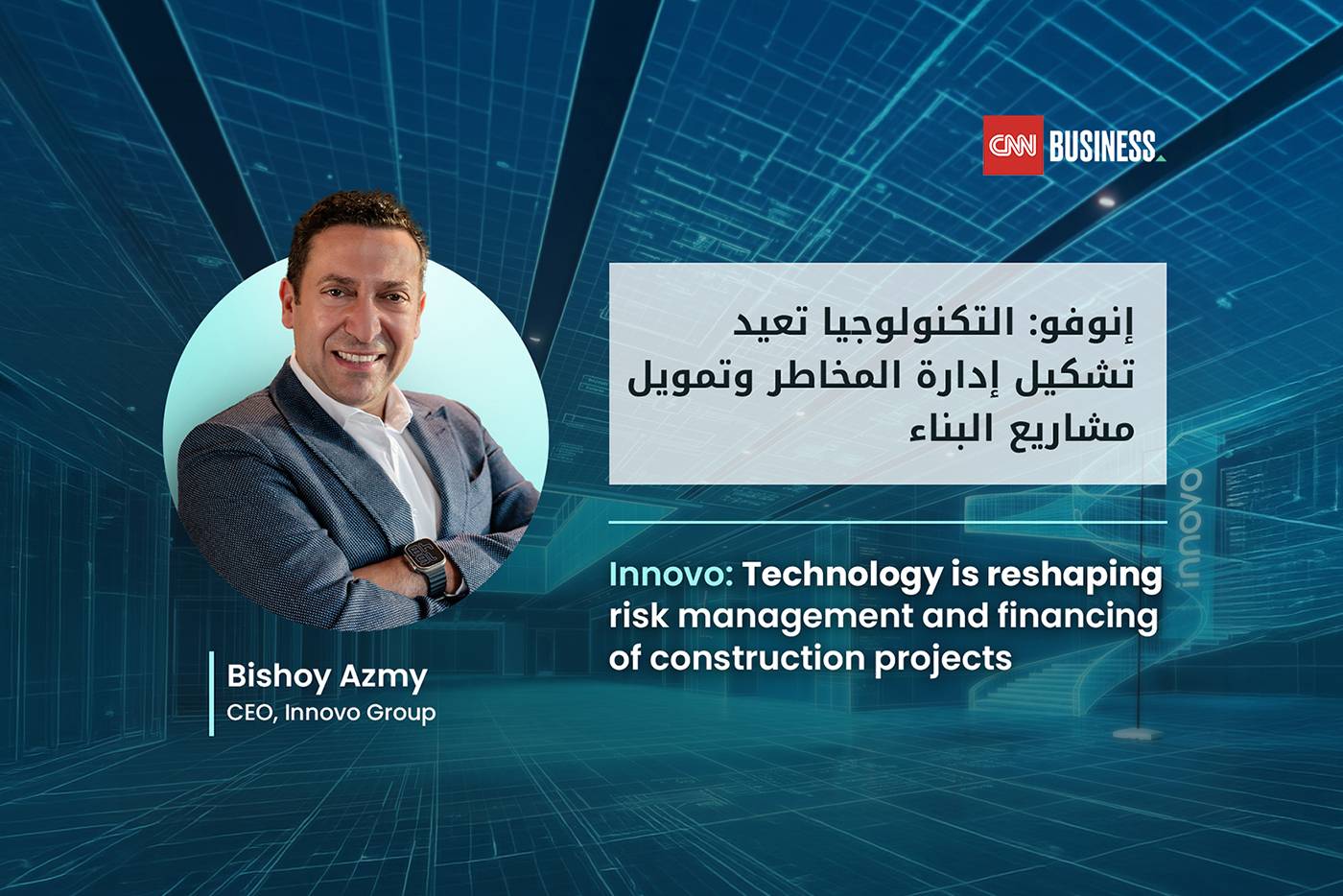
Bishoy Azmy on technology reshaping construction risk and financing
Thought Leadership
07-10-2026
On the sidelines of Investopia Bridge 2026, Bishoy Azmy, CEO of Innovo Group, speaks about the transformation of the construction sector in the region, and the role of technology and innovation in developing more efficient models for risk management and project finance.
Governments across the region are moving forward with some of the world's most ambitious infrastructure and urban development agendas, why do you describe this as a critical turning point for innovation in the construction sector?
The region's construction sector is undergoing a real transformation, driven by the scale of urban ambitions and accelerated investment in infrastructure projects, in parallel with the increasing complexity of projects and the requirements for their implementation, especially in the UAE, where the output of the construction sector is expected to grow by 6.2% to reach AED 189.59 billion in 2026.
With more than 130 projects under implementation at Innovo, we see that an increasing aspect of risk is no longer linked to a single phase of the project, but to the intersections between design, engineering, implementation, finance and technology, and this is reshaping the concept of competitiveness in the sector.
Innovo was founded from day one on technology and innovation; in practice, what does "reimagining the construction sector" mean in a project under implementation today, compared to the traditional way the sector has worked?
Reimagining the construction sector for us starts from changing the way decisions are made, as the more basic decisions can be made at an early stage and linked to an integrated system, the more efficiently the project can be managed from design to implementation.
This requires moving beyond the traditional model in which design, engineering, procurement and implementation work is sequentially moved, and challenges often arise when moving from one stage to another, so at Innovo we are keen to integrate construction, mechanical, electrical and plumbing (MEP), infrastructure, real estate development, procurement, and technology investment into a single package, so that the teams involved continue to work on solutions from design to implementation.
Through this approach, the technology in our projects in the UAE has become part of the actual decisions regarding timeline, cost and safety, rather than a separate path from the implementation process.
The construction industry has historically suffered from limited profit margins and high levels of risk, does the integration of technology at Innovo only improve efficiency on the job site, or does it provide a fundamentally different business model for financing and executing projects?
The clearer the project path, the more confident entrepreneurs, financiers, and investors will be in the decisions related to financing and investment, and accurate data on the implementation process provides a clearer view of the risks associated with the timeline, capital deployment, and investment assumptions, helping to address problems before their cost rises.
At Innovo, we adopt an integrated model that covers the various phases of the project from start to finish, allowing us to approach these elements in a coherent manner, rather than focusing on one aspect of the site work in isolation from the rest of the project, and by linking procurement and risk management to clear performance indicators, it becomes easier to support and scale up the implementation of practical innovations.
You recently signed a partnership with the Dubai PropTech Hub at the Dubai International Financial Centre (DIFC), why did Innovo choose to join the hub at this time, and what gap does the partnership aim to bridge in the region's innovation ecosystem?
There is a big difference between proving that technology works in a pilot environment and proving that it can work in an actual construction project, and this is precisely the gap we seek to address by joining as a founding partner of the Dubai PropTech Hub, an initiative of DIFC Innovation Hub.
According to the Dubai Media Office, the centre aims to attract more than 200 startups, create more than 3,000 jobs and attract more than US$300 million in investment by 2030.
Through the Global Landing Pad programme and our portfolio, we can offer the opportunity to apply and test new solutions in actual projects, starting in Dubai, and then in other markets where we operate.
Under the agreement, Innovo will allow startups participating in the Global Landing Pad program to test their technologies within their ongoing projects, how will this work? And what will it mean for your customers?
The idea is to give selected startups the opportunity to test their technologies within existing and ongoing projects, and to assess their ability to address actual challenges facing the project, while maintaining project management controls and client requirements at all stages of implementation.
Testing these technologies on the job site is becoming increasingly important, with half of the participants in the first cohort of the Global Landing Pad program focusing on the pre-construction and construction phases, allowing project sites to test their technologies in the actual work environment and evaluate their performance against clear pre-agreed criteria.
This is the real test of any new technology; it is not enough to succeed in a pilot environment, but it must prove its ability to work within an existing project, under the pressure of schedule, engineering requirements, and safety responsibilities.
For our clients, this means that new technologies have been tested against actual construction challenges before being used in their projects, enhancing confidence in cost, timeline and execution flow.
Artificial Intelligence, Robotics, Digital Twins, and Automation dominate the debate about the future of the construction sector, which of these technologies has gone beyond the testing phase and has become part of the daily use of your sites? What measurable difference have you made in terms of cost, speed or safety?
Some technologies have moved from pilot to actual use in our projects, foremost among them digital twins, and we have also started to introduce AI-powered robots to implementation sites.
This is evident in the Louvre Residences project in Abu Dhabi, where we use a four-dimensional digital twin, developed based on the project's Building Information Model (BIM), to track the progress of the works in real-time and compare it to the design and schedule, contributing to early detection and remediation of problems at a lower cost.
At Majid Al Futtaim's AED 1.7 billion Ghaf Woods project in Dubai, we use multitasking robots from FieldAI to track business progress and collect data independently, even in the UAE's high temperatures.
We recently reviewed some of these applications during the visit of H.E. Abdulla bin Touq Al Marri, Minister of Economy and Tourism, to one of our other projects in Dubai, where he was briefed on the use of artificial intelligence, robotics, automation and digital solutions in the implementation processes.
I believe that the challenge facing the construction industry today is not a lack of innovation, but rather its wider application, as Statista's data shows: in the first quarter of 2026, the percentage of AI use among working-age individuals in the UAE was 70.1%, while only 12% of companies operating in the built environment regularly use it.
When you use third-party real estate tech startups and AI tools for large, complex development projects, who is responsible when automated predictions or digital twin models conflict with the engineering reality on the ground?
When the outputs of automated systems conflict with the engineering reality on site, the final decision must be in the hands of specialists, as technology for us is a tool that supports expertise and professional judgment, and does not replace human responsibility.
This principle is reflected in the way we work, as engineering decisions remain subject to review and approval by specialists, while maintaining human control and the power to stop work when necessary, and this also applies to the external technologies we test.
As the role of interconnected data and artificial intelligence in the decision-making process grows, data quality and governance become more important to ensure the integrity of engineering decisions, so teams must be aware of the capabilities and limitations of these systems, and responsibility for the final decision is clear on-site.
Much of the debate on the efficiency of the construction sector is focused on modular construction and off-site manufacturing, to what extent is industrial construction a central element of Innovo’s strategy for implementation in the region?
Industrial construction is an essential part of our implementation strategy, especially when it contributes to reducing variability and improving the ability to plan and execute within an integrated project model.
This is evident in our MEP business, where we prefabricate units off-site according to design principles for manufacturing and assembly, reducing construction time, enhancing quality control, reducing conflicts between different systems, and leveraging our manufacturing facilities to produce prefabricated solutions for data centres, including enclosed units.
The value of this approach lies in the fact that it can be replicated with consistent efficiency, as when design, manufacturing and implementation are coordinated on-site from the earliest stages, conflicts can be addressed before they arrive on site, supporting adherence to the timeline and reducing the risk of coordination during implementation.
Sustainability is often discussed in isolation from innovation, how does Innovo use new building materials and methods to reduce the environmental footprint of its projects without affecting the speed of implementation or cost?
We treat environmental performance as part of the implementation process, because more sustainable solutions cannot be applied at scale unless they are able to meet the project's requirements in terms of cost and timeline.
We use our iEnergy platform to monitor on-site energy consumption in real-time, including generator efficiency, fuel consumption and emissions, allowing teams to detect inefficiencies as they arise.
This approach extends to the use of renewable energy in our operations, where we installed solar energy systems with a total capacity of 644 kW in the UAE, and in 2025 the volume of emissions avoided by solar energy increased to 297,660 kilograms of CO2, compared to 192,279 kilograms the previous year.
Together with the use of recycled materials, low-carbon procurement, and waste sorting on the jobsite, these actions reflect an approach that links sustainability to efficiency of implementation, rather than treating it as a separate factor that slows down implementation.
The construction industry is still highly human-centric even as technology has become more natural, how are you building the skills, culture, and safety standards required by a technology-driven workforce across your markets?
Our vision for the use of technology in the construction sector is based on the priority of safety and worker well-being, as no productivity gains should come at the expense of our responsibility to people on the job site.
Each employee and every stakeholder in Innovo projects has the power to stop work if they deem it to be a safety risk, regardless of what any digital system may recommend, and this commitment is also exemplified through the Innovo Safe Access programme, which provides shaded and air-conditioned rest areas, along with specialised care and wellbeing teams, and this approach has been recognised by the Government of Dubai.
This priority is clearly reflected in our projects: DP World Sokhna in Egypt has logged two million safe man-hours without lost time injury.
As much as we are keen to make the use of technology safer, we also believe in the importance of investing in the human competencies behind it, so I believe that employing technology in the construction sector requires greater investment in the development of human competencies, which is why we are contributing to the launch of the first Innovo Applied Technology School in Egypt.
Dubai has set targets through the D33 Agenda and the Real Estate Sector Strategy 2033. What role can cooperation between the government, financial centres and contractors play in making the city a global platform to test innovation in the construction sector?
Public-private collaboration represents an opportunity to establish Dubai as a global platform for testing and implementing solutions, by linking government ambitions to investment and the ability to implement and focusing on clear and measurable results.
The D33 Agenda provides the basis for this trend, with a total economic target of AED 32 trillion over ten years, and according to the official portal of the UAE government, which aims to achieve AED 100 billion annually from digital transformation, and to turn these ambitions into viable opportunities, the Dubai PropTech Hub in DIFC is a link between technology companies, capital, and opportunities for implementations.
Solutions that have proven successful in the UAE can be taken to African markets and scaled up, leveraging accumulated experience and adapting operating models to the conditions of each market.
Through this system, contractors can support the implementation process with project data and operational expertise, while government entities and financial centres can develop procurement mechanisms and standards and enhance investment readiness, thus making the implementation path a tangible factor that project owners and investors can evaluate and make financing decisions based on.
A large part of future global urbanisation will occur in the Global South, including the African markets where Innovo already operates, how can solutions that have proven successful in the UAE be adapted and scaled up there?
Solutions that have proven successful in the UAE can be taken to African markets and scaled up, leveraging accumulated experience and adapting operating models to the conditions of each market.
We already have offices in Egypt, London and Canada, and we are testing many solutions and transferring the experiences and lessons we have learned in the UAE.
Looking ahead to 2033, how do you expect the way cities are designed, built, and experienced to live and work in cities will change, and what role do you want Innovo to play in this change?
By 2033, I predict that cities will become more responsive to the needs of those who live and work in them, and that data will play a greater role in linking design decisions to long-term construction and operating performance.
Innovo will contribute to building this future by integrating construction, infrastructure, development, finance and technology into one integrated suite of the built environment, and with more than 130 projects underway, we have a broad base to share experiences and transfer proven solutions and methods from one market to another.
Our role will be to address project challenges from the earliest stages, enhance the efficiency and reliability of implementation, and bring practical innovations that have proven successful in Dubai to international markets and expand their application globally.
Source: CNN Business Arabic